LEADING POLICE AND PRISONS CIVIL RIGHTS UNION (POPCRU) FOR OVER 25 YEARS Dr Zizamele Cebekhulu-Makhaza is a celebrated leader and social activist who has served as the President of the the union since 1996.
A goal-driven, versatile leader with strong organisational and communication skills, POPCRU has continued to grow from strength to strength under the guidance of Dr Zizamele Cebekhulu-Makhaza, achieving an impressive track record in safeguarding the rights and interests of South Africa’s police and correctional service members.
Dr Zizamele Cebekhulu-Makhaza’s servant leadership drives commercial and societal change
From humble beginnings in 1989, Police and Prisons Civil Rights Union (POPCRU) has grown to 160,000 members today. With a strategic focus on increasing shareholder value, the union’s investment wing, POPCRU Group of Companies (PGC), generates and invests financial capital on behalf of its union members. Having generated R1.8 billion in corporate value through strategic acquisitions over the past 20 years, Zizamele Cebekhulu-Makhaza has been skilfully directing operations since becoming POPCRU’s President in 1996.
He joined the South African Police Force in 1983 after giving up in his dream of becoming a teacher due to a lack of finances. Cebekhulu-Makhaza was stationed in Mpumalanga where he realised the stark differences in the treatment and conditions between black and white police officers. This is what led to Cebekhulu-Makhaza recognising the potential the union had in rectifying what black officers knew to be wrong with the system. Inspired by the union’s ability to positively shape the lives of policemen and women for the better, Cebekhulu-Makhaza joined POPCRU in 1991.
While optimistic about the union’s potential to bring about inclusivity and transformation, he understood the hurdles the POPCRU faced, including not being registered or recognised by the government at the time.
With a vision for large-scale change, Cebekhulu-Makhaza became instrumental in establishing the Standerton branch of POPCRU which he led as chairman. Despite the tumultuous political environment, he significantly grew the membership for the Mpumalanga province, becoming one of the top five branches in the country.
Just before the dawn of democracy, POPCRU was officially registered as a union in 1993 and as an affiliate of the ANC, SACP and COSATU. From this point POPCRU worked to drive the narrative of transformation, equality and non-racialism within the police and correctional systems.
Along with a change in the political dispensation came the inclusion of the South African Police Force, 11 homeland security agencies and non-statutory forces, which were all incorporated into the new South African Police Service.
POPCRU successfully unified the various security and police branches that existed under the apartheid regime. This feat was achieved with no internal tensions or break-away factions which caught the attention of Germany at the time. The German Police Union had been struggling to amalgamate the police forces from East (socialism) and West (capitalism) Germany after the fall of the Berlin Wall and the country’s unification.
On Owing to of POPCRU’s model and on-the-ground input, Germany was able to create one united police force. Cebekhulu-Makhaza also played an imperative role in developing a similar model in Holland. This propelled Cebekhulu-Makhaza to approach other African countries to emulate polices of inclusivity, with successes in Lesotho, Mozambique, and Zambia.
While in Germany sharing their expertise, Cebekhulu-Makhaza and his team learned about the German union’s commercial arm and recognised the financial value it could add back home. Cebekhulu-Makhaza knew that this was key to creating a better life for its members and society at large. As a non-subsidised union, POPCRU needed funds for its operational expenses. This led to the establishment of an operational investment wing, Lesaka, to generate the income required.
It was then when the presidency position of the union became available and Cebekhulu-Makhaza was inaugurated as POPCRU’s new leader in 1996. Due to the prevailing conflict of interest, the commercial wing had to be separated from the union, which led to the birth of the POPCRU Group of Companies (PGC). PGC currently runs various core and non-core businesses, as well as subsidiaries, which have been responsible for driving social and economic value in the country.
Under Cebekhulu-Makhaza’s leadership, membership grew ten-fold, and the union became one of the most reputable in South Africa through its socially transformative and political agenda. POPCRU’s President is a strong advocate of education and is a staunch believer in skills enhancement and self-development. It is with this belief system that he continuously reformulated policy and invested in the best minds, who understood the political landscape and societal issues unique to South Africa.
While driving his leadership team to hone their skills and qualifications to offer POPCRU’s members strategic representation through their bargaining abilities, policy analysis and development, and business acumen, Cebekhulu-Makhaza’s own educational achievements have been exemplary. He recently graduated with a PhD (Doctorate) in Business Administration from the Business School of Netherlands.
Cebekhulu-Makhaza’s passion for education is also evident in the union’s Educational Trust, which takes care of the children and partners of police officers who lost their lives on duty.
POPCRU is also working to establish a Criminal Justice College set to focus on upskilling police officers with forensic training and improved community policing methods.
Further, to help educate and uplift ignorant and often illiterate communities regarding the law,
POPCRU’s Safer South Africa Foundation was formed. It is a non-governmental organisation that educates people, especially children, on legalities that urban dwellers would consider obvious, the mechanics of how the court system works, the role of the police, and correctional facilities.
Being at the helm of one of the biggest labour unions in Sub-Saharan Africa brings with it great power, and as Cebekhulu-Makhaza prepares to hand over the baton next year, he notes how much more needs to be done.
Cebekhulu-Makhaza is aware of the serious societal challenges that still need to be addressed in the country. He says changes within the policing structure are necessary to effect change in the country’s’ crime fighting capacity.
Cebekhulu-Makhaza continues to lobby for his workers’ rights and believes that an improved salary structure and a more comprehensive housing subsidy will go a long way. He is also a firm believer in rehabilitation and wants to see more effective programmes for prisoners.
As a leader with a passion for social change and cohesion, Cebekhulu-Makhaza is a shining example of what can be achieved through an unwavering commitment to improve the lives of others. POPCRU stands as a towering figure in the social development of workers’ rights. The union is proof of what is possible through exceptional leadership, vision and sincere commitment to improving people’s lives.
VIEW MY LINKEDIN PAGE
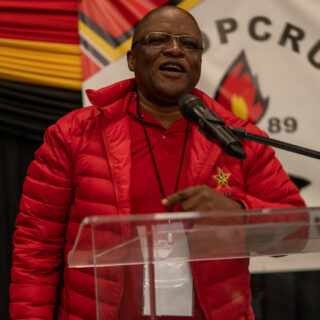
Cebekhulu-Makhaza’s own educational achievements have been exemplary.
In 2021, he graduated with a PHD (Doctorate) in Business Administration from the Business School of Netherlands.
His list of qualifications include:
- BTech in Police Administration from the Technikon of South Africa
- BTech Honours in Policing from the University of South Africa
- MBA Master of Arts in Criminal Justice from the University of South Africa
- MBA: Masters in Business Administration from the Business School of Netherlands
- PhD in Philosophy from the University of South Africa